
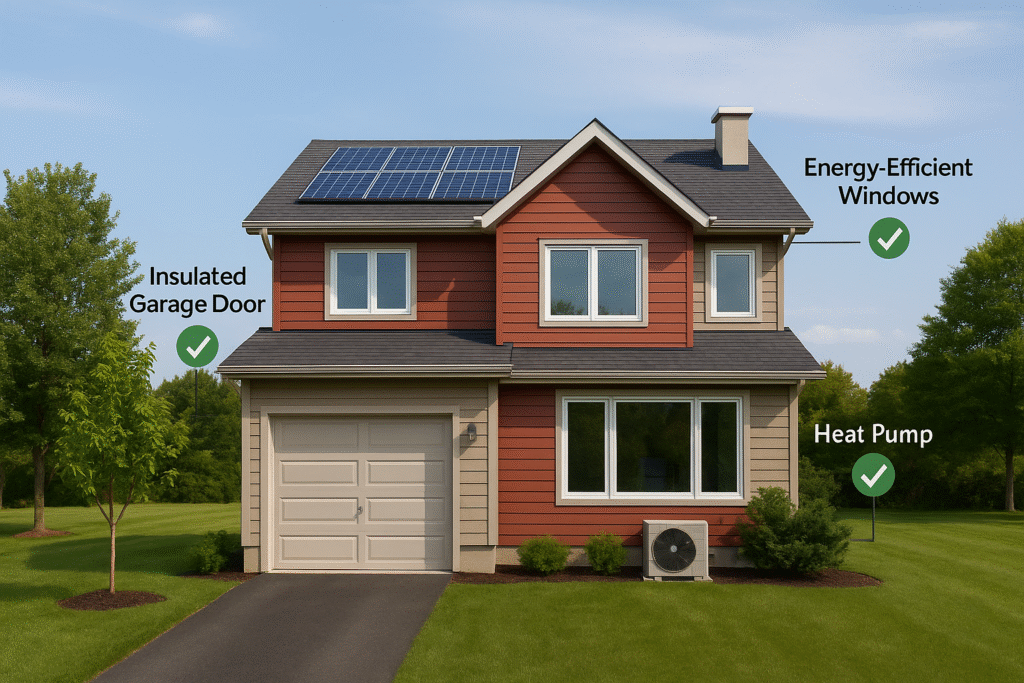
“Modern Canadian energy-efficient home featuring solar panels, triple-pane windows, insulated garage door, and heat pump system — showcasing sustainable living and government rebate opportunities.”
As a green energy adviser, one of the questions I hear most often is:
“What incentives are out there right now in Canada to help me upgrade my home to be more energy efficient?”
The good news is: there are programs available — although their availability, funding levels, and eligibility rules shift over time. In this post, I’ll walk you through the current major federal and provincial rebate & grant programs, explain how to apply, and show you sample savings you might expect.
Why it matters: the value of energy efficiency
Improving your home’s energy efficiency is more than “going green” — it’s a financial investment:
- Lower utility bills (heating, cooling, electricity)
- Increased comfort and resilience
- Reduced greenhouse gas emissions
- Boost to home resale value
- ROI (return on investment) — many upgrades pay for themselves over time
To help homeowners, governments (federal + provincial/territorial) often offer grants, rebates, or loans to offset part of the upfront cost of energy upgrades. Let’s look at key ones in Canada today.
Major Federal Program: Canada Greener Homes Initiative
The Canada Greener Homes Initiative is (or was) the core federal program for home energy-efficiency grants. Natural Resources Canada+2Natural Resources Canada+2
What it offered
- Grants from CAD $125 to $5,000 toward eligible retrofit costs Natural Resources Canada+1
- Up to $600 for two EnerGuide evaluations (pre- and post-retrofit) Green Communities Canada+1
- Retrofits eligible included insulation, air sealing, high-efficiency windows/doors, efficient heating/ventilation systems, solar, and more Natural Resources Canada+2Green Communities Canada+2
However — important update:
As of recent reports, the Canada Greener Homes Grant is no longer accepting new applicants. RBC Royal Bank+2Green Communities Canada+2
But applications submitted before closure are still being processed. Green Communities Canada+1
So while the flagship program is winding down, many provinces have replacement or complementary programs. Let’s dive into those.
Provincial & Local Programs: What’s Available by Region
Each province or territory may have its own incentives, sometimes in partnership with utilities or energy agencies. Below is a sample by region (you should always check your local province/municipality for updates).
| Province / Region | Program Name / Notes | Incentives Offered / Key Features |
|---|---|---|
| Ontario | Home Efficiency Rebate Plus (HER+), transition to Home Renovation Savings Program | Up to $10,000 rebates for insulation, air sealing, windows, smart thermostats, space & water heating systems, etc. Enbridge Gas Note: HER+ intake is closed; pre-retrofit energy assessments must have been done by a deadline. Enbridge Gas+1 Also, Ontario’s Home Renovation Savings™ Program is being rolled out to help homeowners with energy-efficient upgrades under new funding models. Enbridge Gas+2Ontario Newsroom+2 |
| British Columbia | BetterHomesBC / Energy Savings Program | Offers rebates and incentives, sometimes covering up to 100% of upgrade costs for eligible households, plus energy coaching and assessments Better Homes BC |
| Alberta | Existing Home Incentive Program (historical) | Rebates up to $5,000 for insulation, windows, air sealing, etc. Otipemisiwak Métis Government |
| Across Canada | Oil to Heat Pump Affordability Program | Up to $10,000 for homeowners to switch from oil-based heating to an energy-efficient heat pump RBC Royal Bank |
| National / Multi-province | Save on Energy / Home Renovation Savings (in Ontario) | Support and rebates for energy-efficient upgrades in partnership with utility programs Save on Energy |
Note: These programs often have strict deadlines, application windows, and eligibility rules — such as income limits, home age, required audits, and timelines for post-upgrade inspections. Always verify with your provincial or utility provider.
How to Apply: Typical Steps & Tips
Here’s a general process most programs follow:
- Energy audit / evaluation (pre-upgrade)
A certified energy advisor inspects your home, identifies weak points, and issues a report with recommendations. Some programs subsidize or cover part of this cost (e.g. up to $600 under Greener Homes). Green Communities Canada+2Natural Resources Canada+2 - Select eligible retrofit(s)
Use the audit to choose upgrades (insulation, windows, heat pump, etc.). Make sure the retrofit is on the program’s approved list. - Complete the retrofit
Hire certified contractors or use approved products per program guidelines. - Post-upgrade evaluation / audit
After the work, another audit may verify what was done and how effective it is (to claim rebates). Green Communities Canada+1 - Submit claim paperwork
Provide receipts, audit reports, and any forms. Programs have deadlines after which claims aren’t accepted. - Receive grant/rebate
Once approved, you receive payment, usually via cheque or electronic deposit.
Real Data & Case Examples
- Between 2020 and 2024, over 600,000 retrofits were completed under the Canada Greener Homes programs, generating $3.8 billion in energy bill savings over the next two decades. Reddit+1
- The initial federal grant program offered up to $5,000 toward retrofit costs; plus $600 for energy assessments (pre and post) — for a total potential of $5,600 in support. Natural Resources Canada+3Green Communities Canada+3Natural Resources Canada+3
- In Ontario, the HER+ program allowed up to $10,000 in rebates for deep upgrades — e.g., insulation, air sealing, heating system upgrades. Enbridge Gas
Here’s a hypothetical example to illustrate ROI:
Sample Home Upgrade Scenario
| Upgrade | Estimated Cost | Grant / Rebate | Net Cost to Homeowner | Estimated Annual Energy Savings |
|---|---|---|---|---|
| Insulate attic & ceiling | CAD $5,000 | $2,000 | $3,000 | $400 |
| Upgrade windows / doors (ENERGY STAR) | $8,000 | $3,000 | $5,000 | $300 |
| Convert to a high-efficiency heat pump | $12,000 | $4,000 | $8,000 | $800 |
| Totals | $25,000 | $9,000 | $16,000 | $1,500 / year |
In this scenario, the payback period (net cost ÷ annual savings) is around 11 years — not including additional non-monetary benefits like comfort, lower maintenance, and increased home value.
Because these numbers vary by region, home size, climate, and energy costs, your actual ROI might be better or worse — but incentives help tilt the balance.
Challenges & Things to Watch Out For
- Program funding limits — Some rebate/grant programs run out of money or close to new applications (as with Greener Homes). RBC Royal Bank+1
- Strict deadlines — Many require that retrofits and post-upgrade audits be completed by certain dates. Enbridge Gas+2Natural Resources Canada+2
- Upfront capital — You often need to pay for work up front, and then get reimbursed.
- Eligibility rules — Your home age, location, or the retrofit tech must meet specific criteria.
- Administrative complexity — You’ll need proper recordkeeping, certified contractors, compliance with standards, etc.
Tips to Maximize Your Rebate / ROI
- Do a full energy audit first and use that to prioritize upgrades.
- Bundle multiple upgrades (e.g. insulation + windows + heating) — some programs favor “deep retrofits.”
- Choose certified materials and contractors.
- Plan the timing: make sure all work and inspections will be done before program deadlines.
- Keep organized documentation and photos.
- Check for local or utility-based programs in your city or municipality (separate from provincial/federal).
Final Thoughts
Canada’s energy-efficiency programs offer a valuable opportunity for homeowners to reduce energy bills, make homes more comfortable, and decrease emissions — at a lower net cost. Although the federal flagship programs are evolving (or closing to new applicants), many provinces and local utilities are stepping in with their own incentives.